30 August 2010

Shas rabbi prays for Palestinians to perish

Rabbi Ovadia Yosef, the spiritual leader of the Shas party, which has four ministerial seats in the current Israeli government, has prayed for the destruction of the Palestinians. While delivering a sermon, Yosef said "Abu Mazen and all these evil people should perish from this world. God should strike them with a plague, them and these Palestinians."

In 2001, Yosef said, regarding the Arabs, that "it is forbidden to be merciful to them." He called on Israel to "send missiles to them and annihilate them", because "they are evil and damnable". After a controversy arose regarding these statements, Yosef claimed that he had only meant Arab terrorists, and not all Arabs.

Yosef was born in Basra, and was originally named Abdullah Youssef.

The Palestinian Authority and the US State Department have condemned Yosef's latest remarks. The Palestinian negotiator Saeb Erekat has described Yosef's statement as an "incitement to genocide".

Badakhshanis celebrate the Aga Khan's birthday

The BBC has some spectacular pictures of the Tajik province of Gorno-Badakhshan up today (BTW, the picture on the left isn't one of them; this one's from Wikipedia). Among other things, the photo essay shows Isma'ili Badakhshanis in Khorugh celebrating the Aga Khan's birthday last month.

29 August 2010

30 Mosques profiles Masjid Muhammad in DC


View Larger Map

Back when I lived in Washington, D.C., I'd pray at the Islamic Center of Washington, and sometimes at the Indonesian embassy, where I learned the phrase "dalam bulan suci Ramadhan". But one mosque I'd never even heard about until a few days ago is Masjid Muhammad, the subject of an interesting profile on the 30 Mosques/30 States blog. It sounds like this mosque is a lot better integrated into the general Washington, D.C. community than the Islamic Center is. On the other hand, its congregation also faces more of the social problems that plague some parts of the city. It makes you think.

Anyhow, this is one mosque I'd love to visit on my next trip to D.C., in sha' Allah.

24 August 2010

Manufactured hatred

What I first took to be a storm in a tea cup ended up turning into anything but. Even more than the tragedy of September 11, the current mosque controversy will, I think, define for a generation what it means to be an American Muslim. While I'm not an American myself, my wife is American and Muslim, and so, like millions of others, I have a stake in this issue.

What shocks me more than anything about the mosque debate is that being a Muslim in the US is not as "normal" as I once took it to be. After all, I lived in the US for about five years, both in the Midwest and on the East Coast, both before and after September 11. My faith was pretty much never an issue in any of my dealings with non-Muslim Americans. The sense I got from my stay there was that, unlike the current climate in Western Europe, where being a Muslim automatically places you in the "dodgy" category for a large chunk of the population, in the United States you are judged more by your individual actions than any group identity (barring race, but that's not really the subject here). Well, that was then. Reading about the vitriol that surrounds the Park51 project has made me think again.

A Time poll shows a rather disheartening picture of Americans' attitudes about their Muslim compatriots. Only 55% of the people surveyed believe that most American Muslims are patriotic. Yes, that is a majority, but quite a slim one. Again, 55% would agree to a mosque being built in their neighbourhood. That means that we should be prepared for a slew of anti-mosque protests around the US from the 45% who disagree -- the kind of protests we've already been seeing in California, Tennessee and Wisconsin. It gets worse, though: around 30% of Americans think that Muslims should be prevented from occupying the post of president or Supreme Court judge. Only 44% say that they have a favourable attitude towards Muslims. What do you make of numbers like that? I'm not alone in making comparisons between the current American wave of Islamophobia and older, more ingrained European Islamophobia.

Politicians from both major US parties have been falling over each other in making outrageously Islamophobic remarks, the most infamous, of course, being Newt Gingrich's comparison of Muslims to Nazis. If Imam Feisal Abdul Rauf, who is currently touring the Middle East on behalf of the State Department, is a "radical Islamist", as Gingrich claims, then which Muslim is not?

Some media players have not been much better. In particular, News Corporation, which owns the New York Post, the Wall Street Journal and Fox News (among many other media outlets) unleashed the whole furore in the first place. The New York Times, which has launched a concerted and refreshingly sane attack on the mosque rejection movement, still featured a column that accused American Muslims of supporting "illiberal causes", and an article by the editor of National Review Online, who claimed that Park51 was "a Hamas-endorsed Islamic center". This is one example of the kind of demagoguery that has surrounded the issue. Yes, Hamas has "endorsed" the mosque, while "endorsing" churches and synagogues in the same breath. So are the Sarah Palins of this world going to "refudiate" churches next?

The pleasantly surprising part in all this has been that, as Maureen Dowd has pointed out, some of the most spirited defence for Park51 has come from Republicans, namely Michael Bloomberg and Chris Christie. Now Ron Paul has joined this group, issuing one of the most lucid statements that has yet been made in favour of building Park51. It is a sad thought, though, that Ron Paul, of all people, offers more hope on the issue than Barack Obama does.

So there's some hope here that even right-wing Americans will come to their senses. Newsweek suggests that the issue will go away after the primaries. Perhaps it will. But it certainly leaves a very bitter taste in the mouth, one which may linger for years to come. Perhaps one day Muslims will be praised for revitalising Park Place by building Park51 (some are doing so already). But rebuilding a secure place for Muslims in American society will most likely take far longer.

15 November 2009

The Goldstone Report and the Bible

Going through the Bible the other day, I came across a passage that reminded me of the unbridled attacks launched by the Israeli government and its supporters against the Goldstone Report. The report, authored by a commission headed by the eminent South African Jewish jurist Richard Goldstone, accuses both Israel and Hamas of committing war crimes during the Gaza War of 2008-2009.

President Shimon Peres has stooped to calling Goldstone a "small man". I would counter that such language makes my countryman Peres (we were both born in modern-day Belarus) sound like a small man.

The Bible passage I was referring to is Amos 5: 7-15. In citing it here, I am trying to remind the political leadership of Israel of the Biblical values of justice and truth which they have, in this instance, allowed to fall by the wayside. My favourite part of this passage is "Hate what is evil. Love what is good. Do what is fair in the courts. Perhaps the Lord God who rules over all will show you his favour." These are values that all of us should seek to live by.

As Nicholas Kristof points out, there are "two Israels", or even "many Israels". Let us hope that the one that triumphs in the long run is not Netanyahu's Israel or Lieberman's Israel, but rather the Israel that wants to live side by side with its neighbours in a just peace.

-----

Now playing: "Peace Train" by Cat Stevens

Visitor profiles, 15 October to 14 November 2009

Welcome to the twenty-first installment of Notes on Religion visitor profiles!

The most recent month (15 October to 14 November 2009):

This month, Notes on Religion received 759 visits.

Visitors came to Notes on Religion from every inhabited continent, alhamdu lillah. The largest number of visitors (24%) came from Italy (grazie!). The United States was next with almost 24%, while Canada came third with 16%. In sha' Allah, I'll quote all monetary amounts (if any are discussed) in euros along with Canadian dollars over the coming month.

Within Italy, the largest number of visitors (15%) came from Rome.

A plurality of visitors this past month (34%) were referred to Notes on Religion by Google. The most common Google search term that brought visitors to the blog was 'russian neo nazi beheading'.

The most popular browser this month was Internet Explorer (47%). 91% of the visitors were Windows users.

Since the founding of the blog (15 March 2007 to 14 November 2009):

The total number of visitors during these two years and eight months was 11,791. The average number of visitors was 12 per day.

The largest number of visitors (43%) came from the United States. The second-highest number (15%) came from Canada. The United Kingdom came third with 7%.

Within the US, the state with the largest number of visitors (14%) was California, while the city with the largest number (5%) was New York.

The majority of visitors (53%) was referred to the blog by Google. The most common search term entered by visitors who were referred to Notes on Religion by Google was 'russian neo nazi beheading'.

The most popular browser was Internet Explorer (47%). 90% of the visitors were Windows users.

----------------
Now playing: Kathy's Song by Simon & Garfunkel

14 November 2009

Two trials, same disease

So it turns out that Alexander Wiens, the Islamophobe who has recently been found guilty of the murder of Marwa al-Sherbini, is appealing his life sentence at the Federal Court of Justice. Let's hope this court has enough strength of character to reaffirm the sentence.

Meanwhile, the trial of Radovan Karadžić has been postponed until 1 March. Karadžić, of course, has been charged with the murder of 7,000 Muslims in Srebrenica and 10,000 people, most of them Muslims, in Sarajevo, among other crimes. So far, he has been able to obstruct his trial by boycotting it and continually asking for more time to study the charges against him. It seems, though, that, once the trial is well and truly under way, Karadžić should receive a life sentence if even one of the more serious charges against him is proven. Anything less would be a travesty of justice.

The difference between Karadžić and Wiens is simply one of degree. Unquestionably, there is a significant minority of Europeans that believes that there is no place for Muslims in Europe. While most such right-wing extremists spread their views non-violently (see picture), there are those, like Karadžić and Wiens, who evidently believe that European Muslims should be physically exterminated. It is thus reassuring that Wiens received his life sentence, and also reassuring that Karadžić is behind bars, despite the lack of progress in his trial.

The European and international justice system have so far been able to demonstrate that the brazen murder of innocents in Europe will not be tolerated. Thank God for that. However, an almost equally serious problem, in my view, is the seemingly growing political clout of openly Islamophobic movements that, while stopping short of calling for violence against Muslims, do their best to depict European Muslims as enemy aliens.

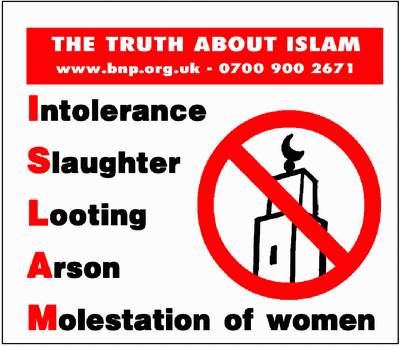
Among such groups I would count the British National Party (BNP). Last May, on a visit to England, I saw a BNP flyer which said, which no apparent shame, that Turkey should be prevented from entering the EU so that "70 million Muslim Turks" would not be able to flock to British shores. I would have thought that such open attacks on a particular group based solely on their religion would be illegal. But apparently not. Take a look at this poster, which makes it clear that opposition to Muslims (not Muslim extremists or whatever, mind, but all Muslims) is a central plank of the BNP's platform. Or look at this poster. Or this one.

Then, of course, there's the Swiss People's Party and its anti-minaret referendum, or Geert Wilders and his call for the Qur'an to be banned in the Netherlands, and for new Muslim immigrants to be kept out of the country. Lighter shades of Islamophobia are evident in Nicolas Sarkozy's campaign to legislate the clothing of Muslim women in France.

While anti-Semitism is, thankfully, on the decline in Europe, it seems that Islamophobia has very quickly taken its place. As Nick Griffin has admitted, this replacement of anti-Semitism with Islamophobia is, often, intentional. It's simply what sells these days.

-----

09 November 2009

Fachrizal Halim on Communism and Islam

My friend Fachrizal had an article published in the Jakarta Post in October challenging the notion that the Indonesian Communist movement was hostile to Islam from its inception.

Fachrizal cites Lenin's appeal to "all labouring Muslims of Russia and the East", and the subsequent support for the Bolsheviks on the part of some Russian Muslims. In Fachrizal's view, this "strategic alliance" was a result of the shared opposition of the Muslims and the Bolsheviks to Western imperialism.

Fachrizal argues that a similar alliance existed in Indonesia between the Communists and the Muslims masses. He concludes that it is time for the Communists' contribution to the formation of modern-day Indonesia to be fully acknowledged.

This is certainly a very interesting take on the issue. The history of cooperation between the Communists and Islamists in the days of Indonesia's struggle for independence is new to me. I do feel, though, that Fachrizal might be somewhat idealistic when he talks about Lenin's attitude towards Russian Muslims. On the other hand, he does acknowledge the fact that Stalin saw no grounds for the compatibility of Islam and Communism. This had a devastating outcome not just for the freedom of conscience of Soviet Muslims, but also in Indonesia, where the pro-Soviet Communists were forced to take an increasingly anti-Islamic stance.

02 November 2009

Comedy night at the synagogue


To those of you who're in Montreal or nearby: I hope to see many (or some) of you at the synagogue tomorrow for a stand-up comedy show featuring Mo Amer and Rabbi Bob Alper. See the poster above for details.

28 October 2009

Tariq Ramadan on the Swiss minaret referendum

On 29 November, the Swiss are scheduled to vote on whether to ban minarets in the country. The referendum was called on the initiative of the Swiss People's Party, described by Swissinfo.ch as a "small ultra-conservative Christian party". The referendum campaign has included some quite shockingly Islamophobic posters, usually depicting minarets as missiles. Meanwhile, the Swiss Foundation against Racism and Anti-Semitism and the Society for Minorities in Switzerland have spoken out against the minaret-ban initiative, as have the Swiss government and seven political parties.

This is one of those instances where I, as a European Muslim, think to myself, "Thank God my family and I live in North America." I can't imagine living in a society where an architectural component of a mosque is compared to a weapon. Yet the 311,000 Muslims in Switzerland (of whom 36,000 are Swiss citizens) have to contend with these and other issues on an ongoing basis.

In an interview given to Arnaud Bédat of the Lausanne L'Illustré, the Swiss Islamic scholar and activist Tariq Ramadan blamed "racism" for the initiative.

Here are some excerpts from the interview (in my translation):

AB: What would you like to say to the Swiss who are being called to the ballot boxes on 29 November to voice their opinion on the anti-minaret initiative?

TR: I would like to tell them that they should not vote with their fears, but with their principles and their hopes, and that it is necessary to preserve the fundamental principles which comprise the Swiss tradition: freedom of conscience and freedom of religion. The UDC [the Democratic Union of the Centre, another name for the Swiss People's Party] is today instrumentalising fear, such as with the posters which transform minarets into missiles. These are old and well known methods, with a racism that is returning today with new targets.

AB: But do you understand these fears?

TR: Certainly. One must respect the fear of ordinary citizens, while one also must resist in civic fashion populist parties which are instrumentalising fear in order to win elections. The majority of our fellow Swiss citizens are not racists: they are afraid and they would like to understand. Swiss people of the Muslim faith have a real responsibility to communicate and explain.... At the same time, one must refuse to allow populism to install itself. The problem is that the UDC initiative is using the symbol of the minaret to target Islam as a religion. I have had debates with Mr. Freysinger. What does he say? That "Islam is not integratable into Swiss society." So he says to me, to me, and I am Swiss like him, that "You are not a good Swiss person, you cannot be one, since your quality of being a Muslim prevents you from being a good Swiss person." That is the foundation of the debate: the problem is Islam, not minarets.

AB: But the minaret, you write so yourself, is not a pillar of Muslim faith.

TR: Yes, but is that a reason to say "Since it is not an obligation, you don't need it"?... Does it have to be that the only good Swiss Muslim is an invisible Muslim? Is this the future of our pluralism and of our living together?

AB: Numerous Islamic countries forbid other religions on their territory -- there are no churches or synagogues in Saudi Arabia, for example. Is it not ultimately logical that part of the West reject Islam on its territory?

TR: This is the oft-repeated argument of reciprocity. It is untenable. Respect for the rights and dignity of people is not a question of trade. It falls to us, to us in Switzerland, to preserve our principles of respect, and to not allow ourselves to be colonised by the unacceptable practices of other societies. Let us say first of all that it is wrong to say that religious minorities are always discriminated against in Muslim-majority societies. There are synagogues, churches and temples [there]. However, one should not deny the fact that discrimination and the denial of rights do occur, as in Saudi Arabia. One cannot hold Swiss citizens and residents of Muslim faith responsible for the actions of certain dictatorial governments from which they have often, by the way, fled for political or economic reasons. What one can expect from them [Swiss Muslims], nevertheless, from a moral point of view, is a denunciation of discrimination and ill treatment. That is something I do not stop doing, which has closed the doors of several countries, such as Saudi Arabia, to me.

AB: Do you dream, as you detractors claim, of a world that is entirely Muslim?

TR: No. I was born, have lived and have studied in Switzerland; my whole philosophical education comes from that. I have always believed that those who do not share my beliefs allow me to be more myself. The absolute power or uniformisation of a religion on earth would mean corruption and death. The worst that could happen to Muslims is if the whole world became Muslim! That is not even what God's project is. There has to be diversity and difference. Because difference teaches us humility and respect.

AB: When you hear Michel Houellebecq declare that "Islam is the most stupid religion in the world," how do you react?

TR: I do not react to this type of provocation. Thinking that a religion can be the most stupid on earth is a little stupid, is it not?

AB: Some rapid-fire questions, to be answered with a "yes" or a "no". Do you condemn all types of fanaticism?

TR: Yes. All types of fanaticism and dogmatism, wherever they come from.

AB: Do you condemn hostage taking, such as that of Shalit in Israel?

TR: Yes. And that of thousands of Palestinians, too.

AB: Can one recruit a child suicide bomber in the name of Islam?

TR: No.

AB: Do you condemn Iran, which is suspected of building a nuclear weapon?

TR: Yes. I condemn all possession of nuclear weapons, without exception.

AB: Do you recongnise the right of Israel to exist?

TR: Yes.

AB: Are you for or against civil partnerships?

TR: I am for them. I have even gone further, in saying to Muslims that civil partnerships could be a contractual framework of interest to Muslim citizens.

AB: Are you going to set out into politics one day, as some have been hinting?

TR: An absolute "no". My feelings are left-leaning. If someone forced my hand, I can see myself in a pro-ecological party more than anything.

AB: Have you at times been the target of extremists?

TR: I have received threats. Nothing serious.

AB: You must be one of the most listened-to people by all the secret services of the planet, right?

TR: That does not matter to me much. I try to hold to a single line: my political engagement is clear.

Let's hope the initiative to ban minarets fails, along with every other attempt to deny Muslims their place in European society.

-----

21 October 2009

Bosnian Serb jailed for genocide role

Milorad Trbić, an officer of the erstwhile Bosnian Serb army, has been sentenced to 30 years in jail by the Court of Bosnia and Herzegovina for his role in the Srebrenica Massacre of 1995, in which over 8,000 Bosnian Muslims were killed.

The court found that, as the Duty Operations Officer of the Zvornik Brigade of the Army of Republika Srpska in July 1995, Trbić "significantly contributed to the implementation" of the massacre, and did so "with genocidal intent".

Meanwhile, talks aiming to resolve disputes over power sharing in the loose federal structure of Bosnia-Herzegovina have apparently stalled. According to Valentin Inzko, the Austrian diplomat serving as the High Representative for Bosnia-Herzegovina, "Bosnia is in a state of paralysis".

The possibility of a return to violence has been voiced by some observers. Although that is highly unlikely, it seems the wounds have still not healed.

19 October 2009

Syria trying to attract Belarusian pilgrims

Syria has expressed its interest in attracting Belarusian Christian tourists. According to the Syrian ambassador to Belarus, Dr Farouk Taha, "Syria is the cradle of the Christian culture and religion: there are a lot of religious monuments which are very important for the believers there."

Taha wants the Belarusian travel industry to promote Christian religious trips to Syria.

----------------
Now playing: Dexter Gordon - Willow Weep For Me
via FoxyTunes

17 October 2009

23% of the world's population is Muslim

According to a new report issued by the Pew Forum on Religion and Public Life, Muslims number 1.57 billion, which is 23% of the world population of 6.8 billion people.

According to the study, Indonesia has the largest Muslim population (203 million), followed by Pakistan with 174 million, India with 161 million, Bangladesh with 145 million and Egypt with 79 million.

Over 300 million people, representing a fifth of all Muslims, live in non-Muslim-majority countries (India being the prime example).

Russia has the largest Muslim population in Europe, with 16 million. In the Americas, the United States has the largest Muslim population, with 2.5 million (0.8% of the US population), followed by Argentina (0.8 million; 1.9% of the population) and Canada (0.7 million; 2% of the population).

The Pew study is based on approximately 1,500 sources.

----------------
Now playing: Dan Gibson - Breton Children's Song
via FoxyTunes

Visitor profiles, 15 September to 14 October 2009

Welcome to the twentieth installment of Notes on Religion visitor profiles!

The most recent month (15 September to 14 October 2009):

This month, Notes on Religion received 643 visits.

Visitors came to Notes on Religion from every inhabited continent, alhamdu lillah. The largest number of visitors (30%) came from the United States. Italy was next with 17%, while Canada came third with 14%. In sha' Allah, I'll quote all monetary amounts (if any are discussed) in US dollars along with Canadian dollars over the coming month.

Within the US, the largest number of visitors (11%) came from California.

A plurality of visitors this past month (45%) were referred to Notes on Religion by Google. The most common Google search term that brought visitors to the blog was, unfortunately, 'beheading video'. Needless to say, I don't have any such videos up on this blog.

The most popular browser this month was Internet Explorer (43%). 89% of the visitors were Windows users.

Since the founding of the blog (15 March 2007 to 14 October 2009):

The total number of visitors during these two years was 11,032. The average number of visitors was 12 per day.

The largest number of visitors (44%) came from the United States. The second-highest number (15%) came from Canada. The United Kingdom came third with 7%.

In the US, the largest number of visitors (14%) came from California.

The majority of visitors (54%) was referred to the blog by Google. The most common search term entered by visitors who were referred to Notes on Religion by Google was 'russian neo nazi beheading'.

The most popular browser was Internet Explorer (47%). 90% of the visitors were Windows users.

----------------
Now playing: Jaromír Nohavica & Kapela - Petěrburg
via FoxyTunes

13 October 2009

BD Islamic University facing medical shortages

We in Canada often complain about the shortage of medical staff in the country. I have myself witnessed the ridiculous waiting times that result from the relatively low number of doctors and nurses who work in Quebec.

As this fascinating map and the accompanying data show, Canada has 470 people per doctor, whereas the US has only 390 (I know that millions lack access to medical care there, but here I'm talking about supply, rather than distribution). My native Belarus has 220 people per doctor, which means that Canadian-style waiting times are virtually unknown there.

Bangladesh, on the other hand, has 3,800 people per physician. That means that Canada has eight times as many doctors per unit population as Bangladesh.

The Dhaka Daily Star reports that the medical centre of the Islamic University, located in the Kushtia District, currently has only ten doctors and nine nurses for the 12,000 students, faculty and staff at the university. The rate of 1,200 people per doctor is still much better than the Bangladeshi average. To make matters worse, though, two of the doctors are currently on leave. The medical centre has only two pharmacists, which often results in "peons and computer operators" being press-ganged into pharmacy duty to deal with the sheer numbers of patients in need of medication.

The medical centre has asked the vice-chancellor of the university, M. Alauddin, for additional staff, and is currently reduced to "waiting for steps in this regard".

I wonder if Alauddin has the financial wherewithal at hand to be able to fulfill the request.

There are many people in Bangladesh who are much more vulnerable than Islamic University students. Consider helping if you can.

11 October 2009

Rabbi Alan Bright on fasting in Judaism

Ramadan went by with its usual speed this year, and we are nearing the end of Shawwal. Meanwhile, the Jews have celebrated the High Holy Days, one of which, Yom Kippur, involved one of the most important fasts of the Jewish calendar.

During Ramadan, all Muslims read or hear the Qur'anic verse "You who believe, fasting is prescribed for you as it was prescribed for those before you, so that you may be mindful of God" (2:183). "Those before you" refers to older communities of monotheists, including the Children of Israel. I therefore asked my friend Alan, rabbi of the Shaare Zedek synagogue here in Montreal, to share with us his perspective on fasting in Judaism.


Atonement through Affliction

by Rabbi Alan Bright


Islam follows a solely lunar calendar; as a result, the cycle of twelve lunar months regresses through the seasons over a period of about 33 years. Judaism, however, follows a quasi-lunar calendar or, as it has become known, a “lunisolar” calendar. As the Jewish festivals are quired by Torah mandate to fall in specific seasons, months are intercalated according to the Metonic cycle, in which 235 lunations occur in nineteen years. In our days, the Jewish calendar is predominantly used for religious observances; however, it is used by traditional Jewish farmers in Israel as an agricultural framework.

Due to the mechanics of both the Muslim calendar and the Jewish calendar, Yom Kippur, the holiest day of the Jewish calendar, followed the holy month of Ramadan, the most sacred time of the year for Muslims, by approximately one week this year.

A question that is often asked of me;

“Is there a corollary between the fasting within the Judaism and Islam”?

Ask a Jew why he/she fasts on Yom Kippur (the most widely observed fasts of numerous fasts within the Jewish calendar) and the answer will most likely be “to atone for our sins”. Suffice it to say that this vague answer is only one facet of repentance for a Jew.

Ask a Muslim why he/she fasts during Ramadan and the answer most likely will be "to create a greater awareness of God". Awareness of God and his presence is called "Taqwa", a word that can also mean "fear of God", "piety" or "self-restraint". Another reason many Muslims give for fasting is "to feel more empathy for the poor and indigent".

While both these great Abrahamic faiths include fasting as part of their doctrine, they do so for very different reasons.

From sunset Sunday September 27th through dark Monday September 28th, Jews around the world observed the festival of Yom Kippur. For this year only, these dates correspond to the dates outlined in the Old Testament. In the book of Leviticus the following is found:

    ...In the seventh month, on the tenth day of the month, you shall afflict your souls, and you shall not do any work ... For on that day he shall provide atonement for you to cleanse you from all your sins before the L-RD. -Leviticus 16:29-30

The name of the seventh month in the Jewish calendar is Tishrei. So from the evening of the ninth day of the month of Tishrei until the following evening, (Leviticus 23:32), the holiest day of the year in the Jewish calendar is observed.

Even though not stated directly, i.e., “on this day you shall abstain from eating”, this, however, is the place from whence the concept of fasting in Judaism is derived. The question that begs to be asked is how did the rabbinic sages arrive at an interpretation of “you shall afflict your souls” to mean an abstention from all food and drink?

Throughout biblical literature, we find cases of great people who took it upon themselves to abstain from food and indeed other luxuries in order to repent for wrongdoing. For example ,in the Book of Samuel II, we read that King David –- King of Israel -- atones for his unacceptable sexual proclivities towards Bathsheba by fasting while praying to God for forgiveness. This motif of fasting as atonement for prior sins either committed or even contemplated became an accepted mode of repentance throughout Jewish history to present day. Furthermore, we find the same not only for individuals, but also for congregational penance. It is believed that fasting arouses the compassion of God to forgive the penitent for not only negative behavioral situations, but also to implore God's protection in times of calamity either personal or communal.

To answer our question about how the rabbinic sages arrived at the interpretation of “you shall afflict your souls” to mean the abstention from all food and drink,

Rabbi Arnold Bienstok in his essay on Fasting in the Jewish Tradition states that the rabbinic commentators interpreted the Biblical phrase “affliction of the soul” to embrace a generic understanding of denying oneself physical pleasure on Yom Kippur. The prohibitions included not just eating and drinking, but also bathing, washing, and anointing. Sexual abstinence also becomes part of the rabbinic understanding of “affliction of the soul.” Even the wearing of leather is prohibited because of its association with luxury or rabbinic compassion for animal life (tsaar baalei hayyim).

As stated earlier, fasting is found in the books of the Bible. Throughout biblical Judaism, the prophets develop the concept of Divine appeasement by fasting as it serves to transform the individual spiritually. Bienstok further comments that for the prophetic voice, ethical perfection is the ultimate demand of the religious life. Ritual behavior is meaningful only if it is marked by the inner transformation of the character of the penitent. The prophetic voice condemns ritual expression that is not marked by spiritual transformation. Rabbinic tradition selected the Biblical readings of Leviticus 23 and Isaiah 58 as the readings of Yom Kippur to share a balanced perspective on fasting. Leviticus 23 presents fasting as a propitiatory offering of atonement. Isaiah 58 asserts that the genuine fast is self-evaluation.

* Rabbi Alan Bright, a native of London, England, is the spiritual leader of Shaare Zedek Congregation, Montreal Quebec. Born into a modern orth'odox Jewish family, Alan attended seminaries in the UK and USA, namely Jews' College (UK), Yeshivat Rivevot Ephraim and The Jewish Theological Seminary (USA). In addition to Orthodox ordination, Alan holds a Masters' degree from Concordia University, with a major in Ancient and Medieval Jewish History. Alan's area of interest is medieval Jewish death and burial rites and customs. Alan can be reached via email at rabbi@shaarezedek.ca.

07 September 2009

Ramadan reflections from the US on SOF

This Ramadan, "Speaking of Faith" (by American Public Media) has launched a series of Ramadan reflections called "Revealing Ramadan" by Muslims all over the US, as well as a few Muslims living in other places, such as Spain and Britain.

On the series website, you can download the podcast versions of the reflections, or read the text stories that accompany them.

01 September 2009

Harper shows his religious side

In an interview with the Quebec City magazine Prestige, Stephen Harper has said that family is more important to him than political success, and the judgement of God more important than the judgement of future historians.

As Harper put it, "To be honest with you, I am a lot more concerned by God's verdict regarding my life than the one of historians".

Regarding his work-life balance, Harper said, "The important thing, for me, is to preserve family ties. I can win elections, but if I lose my family, it's a disaster."

BTW, Harper belongs to the Christian and Missionary Alliance.

Putting Divine judgement over human judgement and family before work is something I can agree with. These are values I share. The question is, then, why do I still find Harper so creepy?

For one thing, I think, it's because his attitude makes you wonder whether he cares about human beings outside of his family circle. And so, speaking of his concern with "God's verdict" (since he raised the subject), I wonder whether he actually thinks about whether God would approve of his particular actions, such as doing all he can to prevent Canada from taking meaningful steps to reduce its carbon emissions. If he does, I wonder why he remains as he is. Or perhaps he feels he has blanket immunity because of his faith alone?

Muslim charity serves up chicken in Toronto

According to its website, the Muslim charity MuslimServ, based in Brampton, has delivered 2,898 lbs of chicken to the Daily Bread Food Bank in Toronto this Ramadan. They're planning to make two more deliveries, on the 7th and the 14th of September.

What I most like about this programme is that it helps Muslims who donate their money to the organisation take part in helping their needy neighbours, regardless of religious or other differences.

What I don't understand, however, is the focus on chicken. Last Ramadan, MuslimServ donated a total of 14,000 lbs of chicken, and is hoping that people will ramp up their donations of money this year, allowing it to donate more chicken to the food bank. My question is: why only chicken? Why not donate a variety of food items?

Dalai Lama supports Taiwan democracy

On a visit to Taiwan, the Dalai Lama called on the Taiwanese people to protect their democratic institutions, saying, "You achieved democracy. That you must preserve".

The Dalai Lama went to Taiwan to visit and pray for the victims of Typhoon Morakot. The visit also had important political dimensions, since he was invited to the island by the opposition. China, as usual, protested against the visit. China and Taiwan do not disagree with each other over the status of Tibet: both the Republic of China (i.e., Taiwan) and the People's Republic of China (the mainland) see Taiwan as an integral part of China (see map).

The Dalai Lama said that Taiwan "should have a very close, unique link with China".

Touring the village of Xiaoling, which suffered from mudslides as a result of the typhoon, the Dalai Lama was reminded of "Buddha's message of impermanence. It is indeed very very sad."

Hsueh Shu-Chun, who lost her entire family save her husband, said that "Praying for the victims brings relief not only to them but to survivors like me."

Something Even More Magical

In other news...