Showing posts with label UK. Show all posts

02 September 2010

Will the Pope be swayed by bus ads?

In the run up to Pope Benedict XVI's visit to Britain, scheduled to take place later this month, a group called Catholic Women's Ordination (CWO) has unveiled a London bus ad campaign that features signs on the exterior of buses saying "Pope Benedict -- Ordain Women Now!"

The campaign cost the CWO ₤15,000 (Can. $24,332 / € 18,003) for a month's worth of ads. Pat Brown, a spokeswoman for the group, said, "We do not want to be disruptive, but I think the church has got to change or it will not survive."

Meanwhile, the Vatican has asked people planning to attend the Pope's public events in Britain not to bring alcohol or musical instruments. On the other hand, flags and folding chairs are encouraged.

15 November 2009

Visitor profiles, 15 October to 14 November 2009

Welcome to the twenty-first installment of Notes on Religion visitor profiles!

The most recent month (15 October to 14 November 2009):

This month, Notes on Religion received 759 visits.

Visitors came to Notes on Religion from every inhabited continent, alhamdu lillah. The largest number of visitors (24%) came from Italy (grazie!). The United States was next with almost 24%, while Canada came third with 16%. In sha' Allah, I'll quote all monetary amounts (if any are discussed) in euros along with Canadian dollars over the coming month.

Within Italy, the largest number of visitors (15%) came from Rome.

A plurality of visitors this past month (34%) were referred to Notes on Religion by Google. The most common Google search term that brought visitors to the blog was 'russian neo nazi beheading'.

The most popular browser this month was Internet Explorer (47%). 91% of the visitors were Windows users.

Since the founding of the blog (15 March 2007 to 14 November 2009):

The total number of visitors during these two years and eight months was 11,791. The average number of visitors was 12 per day.

The largest number of visitors (43%) came from the United States. The second-highest number (15%) came from Canada. The United Kingdom came third with 7%.

Within the US, the state with the largest number of visitors (14%) was California, while the city with the largest number (5%) was New York.

The majority of visitors (53%) was referred to the blog by Google. The most common search term entered by visitors who were referred to Notes on Religion by Google was 'russian neo nazi beheading'.

The most popular browser was Internet Explorer (47%). 90% of the visitors were Windows users.

----------------
Now playing: Kathy's Song by Simon & Garfunkel

14 November 2009

Two trials, same disease

So it turns out that Alexander Wiens, the Islamophobe who has recently been found guilty of the murder of Marwa al-Sherbini, is appealing his life sentence at the Federal Court of Justice. Let's hope this court has enough strength of character to reaffirm the sentence.

Meanwhile, the trial of Radovan Karadžić has been postponed until 1 March. Karadžić, of course, has been charged with the murder of 7,000 Muslims in Srebrenica and 10,000 people, most of them Muslims, in Sarajevo, among other crimes. So far, he has been able to obstruct his trial by boycotting it and continually asking for more time to study the charges against him. It seems, though, that, once the trial is well and truly under way, Karadžić should receive a life sentence if even one of the more serious charges against him is proven. Anything less would be a travesty of justice.

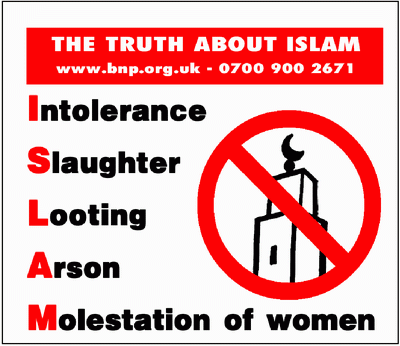
The difference between Karadžić and Wiens is simply one of degree. Unquestionably, there is a significant minority of Europeans that believes that there is no place for Muslims in Europe. While most such right-wing extremists spread their views non-violently (see picture), there are those, like Karadžić and Wiens, who evidently believe that European Muslims should be physically exterminated. It is thus reassuring that Wiens received his life sentence, and also reassuring that Karadžić is behind bars, despite the lack of progress in his trial.

The European and international justice system have so far been able to demonstrate that the brazen murder of innocents in Europe will not be tolerated. Thank God for that. However, an almost equally serious problem, in my view, is the seemingly growing political clout of openly Islamophobic movements that, while stopping short of calling for violence against Muslims, do their best to depict European Muslims as enemy aliens.

Among such groups I would count the British National Party (BNP). Last May, on a visit to England, I saw a BNP flyer which said, which no apparent shame, that Turkey should be prevented from entering the EU so that "70 million Muslim Turks" would not be able to flock to British shores. I would have thought that such open attacks on a particular group based solely on their religion would be illegal. But apparently not. Take a look at this poster, which makes it clear that opposition to Muslims (not Muslim extremists or whatever, mind, but all Muslims) is a central plank of the BNP's platform. Or look at this poster. Or this one.

Then, of course, there's the Swiss People's Party and its anti-minaret referendum, or Geert Wilders and his call for the Qur'an to be banned in the Netherlands, and for new Muslim immigrants to be kept out of the country. Lighter shades of Islamophobia are evident in Nicolas Sarkozy's campaign to legislate the clothing of Muslim women in France.

While anti-Semitism is, thankfully, on the decline in Europe, it seems that Islamophobia has very quickly taken its place. As Nick Griffin has admitted, this replacement of anti-Semitism with Islamophobia is, often, intentional. It's simply what sells these days.

-----

17 October 2009

Visitor profiles, 15 September to 14 October 2009

Welcome to the twentieth installment of Notes on Religion visitor profiles!

The most recent month (15 September to 14 October 2009):

This month, Notes on Religion received 643 visits.

Visitors came to Notes on Religion from every inhabited continent, alhamdu lillah. The largest number of visitors (30%) came from the United States. Italy was next with 17%, while Canada came third with 14%. In sha' Allah, I'll quote all monetary amounts (if any are discussed) in US dollars along with Canadian dollars over the coming month.

Within the US, the largest number of visitors (11%) came from California.

A plurality of visitors this past month (45%) were referred to Notes on Religion by Google. The most common Google search term that brought visitors to the blog was, unfortunately, 'beheading video'. Needless to say, I don't have any such videos up on this blog.

The most popular browser this month was Internet Explorer (43%). 89% of the visitors were Windows users.

Since the founding of the blog (15 March 2007 to 14 October 2009):

The total number of visitors during these two years was 11,032. The average number of visitors was 12 per day.

The largest number of visitors (44%) came from the United States. The second-highest number (15%) came from Canada. The United Kingdom came third with 7%.

In the US, the largest number of visitors (14%) came from California.

The majority of visitors (54%) was referred to the blog by Google. The most common search term entered by visitors who were referred to Notes on Religion by Google was 'russian neo nazi beheading'.

The most popular browser was Internet Explorer (47%). 90% of the visitors were Windows users.

----------------
Now playing: Jaromír Nohavica & Kapela - Petěrburg
via FoxyTunes

11 October 2009

Rabbi Alan Bright on fasting in Judaism

Ramadan went by with its usual speed this year, and we are nearing the end of Shawwal. Meanwhile, the Jews have celebrated the High Holy Days, one of which, Yom Kippur, involved one of the most important fasts of the Jewish calendar.

During Ramadan, all Muslims read or hear the Qur'anic verse "You who believe, fasting is prescribed for you as it was prescribed for those before you, so that you may be mindful of God" (2:183). "Those before you" refers to older communities of monotheists, including the Children of Israel. I therefore asked my friend Alan, rabbi of the Shaare Zedek synagogue here in Montreal, to share with us his perspective on fasting in Judaism.


Atonement through Affliction

by Rabbi Alan Bright


Islam follows a solely lunar calendar; as a result, the cycle of twelve lunar months regresses through the seasons over a period of about 33 years. Judaism, however, follows a quasi-lunar calendar or, as it has become known, a “lunisolar” calendar. As the Jewish festivals are quired by Torah mandate to fall in specific seasons, months are intercalated according to the Metonic cycle, in which 235 lunations occur in nineteen years. In our days, the Jewish calendar is predominantly used for religious observances; however, it is used by traditional Jewish farmers in Israel as an agricultural framework.

Due to the mechanics of both the Muslim calendar and the Jewish calendar, Yom Kippur, the holiest day of the Jewish calendar, followed the holy month of Ramadan, the most sacred time of the year for Muslims, by approximately one week this year.

A question that is often asked of me;

“Is there a corollary between the fasting within the Judaism and Islam”?

Ask a Jew why he/she fasts on Yom Kippur (the most widely observed fasts of numerous fasts within the Jewish calendar) and the answer will most likely be “to atone for our sins”. Suffice it to say that this vague answer is only one facet of repentance for a Jew.

Ask a Muslim why he/she fasts during Ramadan and the answer most likely will be "to create a greater awareness of God". Awareness of God and his presence is called "Taqwa", a word that can also mean "fear of God", "piety" or "self-restraint". Another reason many Muslims give for fasting is "to feel more empathy for the poor and indigent".

While both these great Abrahamic faiths include fasting as part of their doctrine, they do so for very different reasons.

From sunset Sunday September 27th through dark Monday September 28th, Jews around the world observed the festival of Yom Kippur. For this year only, these dates correspond to the dates outlined in the Old Testament. In the book of Leviticus the following is found:

    ...In the seventh month, on the tenth day of the month, you shall afflict your souls, and you shall not do any work ... For on that day he shall provide atonement for you to cleanse you from all your sins before the L-RD. -Leviticus 16:29-30

The name of the seventh month in the Jewish calendar is Tishrei. So from the evening of the ninth day of the month of Tishrei until the following evening, (Leviticus 23:32), the holiest day of the year in the Jewish calendar is observed.

Even though not stated directly, i.e., “on this day you shall abstain from eating”, this, however, is the place from whence the concept of fasting in Judaism is derived. The question that begs to be asked is how did the rabbinic sages arrive at an interpretation of “you shall afflict your souls” to mean an abstention from all food and drink?

Throughout biblical literature, we find cases of great people who took it upon themselves to abstain from food and indeed other luxuries in order to repent for wrongdoing. For example ,in the Book of Samuel II, we read that King David –- King of Israel -- atones for his unacceptable sexual proclivities towards Bathsheba by fasting while praying to God for forgiveness. This motif of fasting as atonement for prior sins either committed or even contemplated became an accepted mode of repentance throughout Jewish history to present day. Furthermore, we find the same not only for individuals, but also for congregational penance. It is believed that fasting arouses the compassion of God to forgive the penitent for not only negative behavioral situations, but also to implore God's protection in times of calamity either personal or communal.

To answer our question about how the rabbinic sages arrived at the interpretation of “you shall afflict your souls” to mean the abstention from all food and drink,

Rabbi Arnold Bienstok in his essay on Fasting in the Jewish Tradition states that the rabbinic commentators interpreted the Biblical phrase “affliction of the soul” to embrace a generic understanding of denying oneself physical pleasure on Yom Kippur. The prohibitions included not just eating and drinking, but also bathing, washing, and anointing. Sexual abstinence also becomes part of the rabbinic understanding of “affliction of the soul.” Even the wearing of leather is prohibited because of its association with luxury or rabbinic compassion for animal life (tsaar baalei hayyim).

As stated earlier, fasting is found in the books of the Bible. Throughout biblical Judaism, the prophets develop the concept of Divine appeasement by fasting as it serves to transform the individual spiritually. Bienstok further comments that for the prophetic voice, ethical perfection is the ultimate demand of the religious life. Ritual behavior is meaningful only if it is marked by the inner transformation of the character of the penitent. The prophetic voice condemns ritual expression that is not marked by spiritual transformation. Rabbinic tradition selected the Biblical readings of Leviticus 23 and Isaiah 58 as the readings of Yom Kippur to share a balanced perspective on fasting. Leviticus 23 presents fasting as a propitiatory offering of atonement. Isaiah 58 asserts that the genuine fast is self-evaluation.

* Rabbi Alan Bright, a native of London, England, is the spiritual leader of Shaare Zedek Congregation, Montreal Quebec. Born into a modern orth'odox Jewish family, Alan attended seminaries in the UK and USA, namely Jews' College (UK), Yeshivat Rivevot Ephraim and The Jewish Theological Seminary (USA). In addition to Orthodox ordination, Alan holds a Masters' degree from Concordia University, with a major in Ancient and Medieval Jewish History. Alan's area of interest is medieval Jewish death and burial rites and customs. Alan can be reached via email at rabbi@shaarezedek.ca.

07 September 2009

Ramadan reflections from the US on SOF

This Ramadan, "Speaking of Faith" (by American Public Media) has launched a series of Ramadan reflections called "Revealing Ramadan" by Muslims all over the US, as well as a few Muslims living in other places, such as Spain and Britain.

On the series website, you can download the podcast versions of the reflections, or read the text stories that accompany them.

22 August 2009

Visitor profiles, 15 July to 14 August 2009

Welcome to the nineteenth installment of Notes on Religion visitor profiles!

The most recent month (15 July to 14 August 2009):

This month, Notes on Religion received 464 visits.

Visitors came to Notes on Religion from every inhabited continent, alhamdu lillah. The largest number of visitors (32%) came from the United States. Italy was next with 12%, while Canada came third with 8%. In sha' Allah, I'll quote all monetary amounts (if any are discussed) in US dollars along with Canadian dollars over the coming month.

In the US, the largest number of visitors (18%) came from California.

A plurality of visitors this past month (41%) were referred to Notes on Religion by Google. The most common Google search terms that brought visitors to the blog were 'natasha aliyeva' and 'neo nazi beheading'.

The most popular browser this month was Firefox (45%). 88% of the visitors were Windows users.

Since the founding of the blog (15 March 2007 to 14 August 2009):

The total number of visitors during these two years was 9,920. The average number of visitors was eleven per day.

The largest number of visitors (45%) came from the United States. The second-highest number (14%) came from Canada. The United Kingdom came third with 7%.

In the US, the largest number of visitors (15%) came from California.

The majority of visitors (55%) was referred to the blog by Google. The most common search term entered by visitors who were referred to Notes on Religion by Google was 'russian neo nazi beheading'.

The most popular browser was Internet Explorer (47%). 91% of the visitors were Windows users.

10 August 2009

On equality in the mosque

As some of you know, Katie and I have recently returned from a two-month trip to Europe. One thing that I love to do while travelling is to discover mosques where I can perform the Friday prayer. In Muslim countries, there are always well established mosques on hand. In non-Muslim ones, depending on how long a Muslim minority has been established there, there are either mosques that look like mosques, or there are buildings converted into mosques from other uses (such as a former cinema I found in Philadelphia), or temporary prayer facilities at university campuses. What's common between all of these places of worship is the welcome they extend to the Muslim worshipper and the sense of brotherhood that almost always emanates from them.

So imagine my surprise when, in Luton, England, I was told that, to the best of my interlocutor's knowledge, mosques there have no "arrangements" for women worshippers. He said there might be something at the university, but, at that stage, it was too late to check. It's always something of a shock to the system to find yourself amid the ultra-conservative Muslims of Luton. Never did I think, though, that the community, which has been in Britain for two or three generations, would continue the common South-Asian practice of excluding women from the mosque. Especially since Luton itself features Islamic schools with female students and women teachers.

My mosque in Dhaka has a women's section, albeit, from what I hear, a small, crowded one, with no view of the men's prayer halls. So Katie was able to attend the mosque in Bangladesh in 2006, but not in Britain in 2009.

After Britain came Belarus. Minsk, my native city, is home to a long-standing Tatar community, present there for over 500 years. There was a mosque in Minsk for most of this time but, tragically, it was first expropriated and then blown up by the city authorities under Communist rule. Since 1997, however, a new mosque has been under construction (very much a stop-go process; the small Belarusian Muslim community is short on funds). The building site features a make-shift structure that serves as a temporary mosque while construction continues. It's actually quite beautiful inside, and includes a women's section, although, again, a small one. Katie and I prayed at this mosque when we were in Minsk; the other places we went to in Belarus didn't have mosques, as far as we knew.

The big shock came in Turkey. Ostensibly, Turkish Islam is all smiles and all kindness. The Turkish Muslims we know are genuinely warm and kind-hearted people, ma sha' Allah. However, something about the way Islamic institutions are managed in Turkey is badly broken. In Istanbul, the mosque where I went for Friday prayer most weeks (because it was located close to the apartment we were staying in) had no women's section.

So one day, Katie and I went off in search of a place where the two of us could perform Friday prayer together. We went to two different mosques in another neighbourhood, and the results were even more surprising. It turned out that both those mosques did have women's sections, BUT those sections were taken over by men during Friday prayers. Thus, of the 35 congregational prayers a week, women could pray at the mosque 34 times. However, they were obliged to stay away for just one prayer, which just happened to be the most important one of the week. Compounding the double standards (if not outright hypocrisy) is the fact that, in one of those mosques, the Friday sermon was about the importance of family, while the prayer featured verses from the Qur'an about the importance of Friday prayer. Hello?

So it was quite comical (sadly so) to see an official from Diyanet, the Turkish governmental agency in charge of Islamic institutions, saying, after a mosque designed by a female architect opened, that Turkey should build more such mosques. That mosque is the first in Turkey designed by a woman, and the first to feature a women's prayer hall equal in size to the men's one. The joke lies in the fact that there is no move underway by Diyanet to admit women into the mosques which currently bar them from taking part in Friday prayer, even though they already have women's sections.

On our way home to Montreal, Katie and I stopped by the Muslim prayer rooms at Atatürk International Airport in Istanbul to perform the fajr prayer. The women's prayer room was spacious and well equipped, but infested with cockroaches. Not surprisingly, I didn't see any cockroaches in the men's one. Katie was glad to leave Turkey, and I don't blame her.

So now we're in Perrysburg, Ohio, visiting my in-laws. Katie and I got married at the mosque here, the Islamic Center of Greater Toledo (see picture), in 2005. This is probably the most equitable of all purpose-built mosques I've seen anywhere in the world when it comes to ensuring women's access to prayer facilities. The prayer hall is simply divided down the middle with a low barrier; men have half the space, while women have the other. The barrier is high enough to ensure modesty, yet not high enough to create a sense of segregation. Men and women have equal access not just to the prayer space, but to the other elements of the mosque, such as the high dome and the stained-glass windows, that give it beauty and help in the contemplation of the Divine.

As Jimmy Carter reminded us last month, "it is simply self-defeating for any community to discriminate against half its population." It is high time for us Muslims around the world to start paying much more attention to the Prophet's (peace be upon him) injunction: "Do not prevent the maid-servant of God from going to the mosque" (Bukhari).

[This post was written in Perrysburg.]

15 July 2009

Visitor profiles, 15 June to 14 July 2009

Welcome to the eighteenth installment of Notes on Religion visitor profiles!

The most recent month (15 June to 14 July 2009):

This month, Notes on Religion received 466 visits.

Visitors came to Notes on Religion from every inhabited continent, alhamdu lillah. The largest number of visitors (29%) came from the United States. Italy was next with 12% (benvenuti!), while Canada came third with 8%. In sha' Allah, I'll quote all monetary amounts (if any are discussed) in US dollars along with Canadian dollars or Turkish lira over the coming month.

In the US, the largest number of visitors (18%) came from California.

The majority of visitors this past month (58%) were referred to Notes on Religion by Google. The most common Google search term that brought visitors to the blog was 'russian neo nazi beheading'.

The most popular browser this month was Internet Explorer (49%). 91% of the visitors were Windows users.

Since the founding of the blog (15 March 2007 to 14 July 2009):

The total number of visitors during these two years was 9,456. The average number of visitors was eleven per day.

The largest number of visitors (46%) came from the United States. The second-highest number (15%) came from Canada. The United Kingdom came third with 7%.

In the US, the largest number of visitors (14%) came from California.

The majority of visitors (56%) was referred to the blog by Google. The most common search term entered by visitors who were referred to Notes on Religion by Google was 'russian neo nazi beheading'.

The most popular browser was Internet Explorer (48%). 91% of the visitors were Windows users.

[This post was written in Istanbul.]

09 July 2009

Visitor profiles, 15 May to 14 June 2009

Welcome to the seventeenth installment of Notes on Religion visitor profiles!

The most recent month (15 May to 14 June 2009):

This month, Notes on Religion received 586 visits.

Visitors came to Notes on Religion from every inhabited continent, alhamdu lillah. The largest number of visitors (41%) came from the United States. Italy (!) was next with 9%, while Canada came third with 8%. In sha' Allah, I'll quote all monetary amounts (if any are discussed) in US dollars along with Canadian dollars or Turkish lira over the coming month.

In the US, the largest number of visitors (13%) came from California.

The majority of visitors this past month (70%) were referred to Notes on Religion by Google. The most common Google search term that brought visitors to the blog was 'russian neo-nazi beheading video'.

The most popular browser this month was Internet Explorer (52%). 92% of the visitors were Windows users.

Since the founding of the blog (15 March 2007 to 14 June 2009):

The total number of visitors during these two years was 8,990. The average number of visitors was eleven per day.

The largest number of visitors (47%) came from the United States. The second-highest number (15%) came from Canada. The United Kingdom came third with 7%.

In the US, the largest number of visitors (14%) came from California.

The majority of visitors (56%) was referred to the blog by Google. The most common search term entered by visitors who were referred to Notes on Religion by Google was 'russian neo nazi beheading'.

The most popular browser was Internet Explorer (48%). 91% of the visitors were Windows users.

[This post was written in Istanbul.]

19 March 2009

Carpet intended for Prophet's (pbuh) grave up for auction

Sotheby's is planning to auction off a carpet once intended to adorn the grave of the Prophet Muhammad (pbuh). The carpet was commissioned in the 1860s by the Maharaja of Baroda (present-day Vadodara, Gujarat, India). Its name, the Pearl Carpet of Baroda, comes from the fact that it is encrusted with about "two million natural seed pearls" from the Persian Gulf.

The Maharaja's death put an end to plans to send the carpet to the Prophet's (pbuh) grave. The carpet travelled from India to Monaco, and is now housed in Qatar.

Bidding is to start at US $5 million (C $6.2 million), but Sotheby's is predicting that the carpet could sell for up to US $20 million (C $24.8 million) (BBC).

In life, the Prophet Muhammad (pbuh) slept on a straw mat or a leather mattress stuffed with fibre. Living a life of humility and simplicity was his conscious choice. God alone knows, but I very much doubt the Prophet would have approved of the decoration of his tomb with literally millions of pearls. So I'm glad that this carpet is being treated as a work of art, rather than a religious object. And I'm certainly glad that it never did end up at the Prophet's graveside.

16 March 2009

Visitor profiles, 15 February to 14 March 2009

Welcome to the sixteenth installment of Notes on Religion visitor profiles!

This month (15 February to 14 March 2009):

This month, Notes on Religion received 952 visits.

Visitors came to Notes on Religion from every inhabited continent, alhamdu lillah. The majority of visitors (61%) came from the United States. Canada was next with 11%, while the United Kingdom came third with 6%. In sha' Allah, I'll quote all monetary amounts (if any are discussed) in US dollars along with Canadian dollars over the coming month.

In the US, the largest number of visitors (14%) came from California.

In Canada, 14% of the visitors' ISPs were in Quebec.

The vast majority of visitors this past month (81%) were referred to Notes on Religion by Google. The most common Google search term that brought visitors to the blog was 'nazi beheading video'.

The most popular browser this month was Internet Explorer (52%). 91% of the visitors were Windows users.

Since the founding of the blog (15 March 2007 to 14 March 2009):

The total number of visitors during these two years was 6,938. The average number of visitors was nine per day.

The largest number of visitors (47%) came from the United States. The second-highest number (17%) came from here in Canada. The United Kingdom came third with 8%.

In the US, the largest number of visitors (14%) came from California.

Quebec accounted for 39% of the visitors' ISPs within Canada.

The biggest proportion of visitors (49%) was referred to the blog by Google. The most common search term entered by visitors who were referred to Notes on Religion by Google was 'russian neo nazi beheading'.

The most popular browser was Internet Explorer (47%). 90% of the visitors were Windows users.

----------------
Now playing: Philip Pickett: New London Consort - Non E Gran Causa
via FoxyTunes

13 March 2009

BBC's Simpson displays prejudices on Iraq

In an article on Tariq Aziz, who has recently been sentenced to 15 years in prison for his contribution to the execution of 42 Iraqi flour merchants in 1992, the BBC's long-serving correspondent John Simpson has made two statements that I find quite surprising because of the outright prejudices contained in them.

First of all, according to Simpson, "although [Aziz] comes from a Christian family, this is a matter of historical chance rather than an indication of his opinions." This statement is, obviously, problematic on a number of levels. Would Simpson say this of a British politician with an unsavoury reputation? Would he take the pains to point out that such-and-such European or North American politician was born into a Christian family and had then gone astray? Moreover, what does it mean to say that the fact that he's a Christian is no indication of his opinions? Can Simpson tell us what opinions a Christian, as understood by him, does hold or should hold? Can he tell us which is the Christian opinion: invading Iraq as the Christians Bush and Blair did, or not invading it, as several different churches (including the Catholic Church, to which Aziz belongs, and which later accepted Blair into its fold) urged? Are Bush and Blair not Christians? If they are, why is Tariq Aziz any less a Christian? And, further, is Simpson trying to say here that Aziz's Baath Party membership would have been more understandable had he come from a Muslim family? If he is saying that, what is that but a calumny?

Secondly, according to Simpson, "Tariq Aziz changed his name from Mikhail Yuhanna... to something much more Arab-sounding, in order to fit in better with his Baathist colleagues". Now, pray tell me, what is not "Arab-sounding" about the name Mikhail Yuhanna? Again, it seems that Simpson is trying to equate "Arab" and "Muslim", and to try to portray the Christians as an anomaly in the Arab world. The fact is, Christian Arabs were present in the Middle East long before the Prophet Muhammad (peace be upon him) had been born. Mikhail Yuhanna is certainly not a non-Arab-sounding name. On the other hand, it is an identifiably Christian name. By renaming himself Tariq Aziz, Yuhanna did not Arabise his name; he secularised it. There is a big difference between the two, which a man of John Simpson's experience ought to be aware of.

11 January 2009

Today we are all Palestinians

Today was the 16th day of Israel's murderous Operation Cast Lead in the Gaza Strip. In order to stop Hamas and other rockets that, over the last several years, have killed 13 Israelis (including three children), the Israeli government has, to date, killed over 800 Palestinians. According to Palestinian Ministry of Health figures accepted by the UN, as of 8 January, the Israeli offensive had killed 257 children and 56 women. And who knows how many of the men killed by Israel were civilians? So who is the terrorist?

I am certainly not taking any kind of ambiguous stance towards the killing of civilians. When Hamas or another Palestinian militant group kills even one Israeli civilian, that is wrong. But what happens when Israel blatantly kills hundreds of Palestinian civilians in a few days? When are we all going to admit that an innocent Palestinian life is just as precious as an Israeli one? When are we going to proclaim loudly that killing a hundred Palestinians is no less evil than killing one Israeli?

As we are told by our Creator in the Qur'an,

We ordained for the Children of Israel that if any one slew a person - unless it be for murder or for spreading mischief in the land - it would be as if he slew the whole people: and if any one saved a life, it would be as if he saved the life of the whole people (Qur'an, 5:32; Abdullah Yusuf Ali's interpretation).

This is something that Hamas would do well to remember. But, in the current circumstances, these words from the sacred text of Islam apply especially to those who are mentioned in them in the first place. Over the years, the thing that has angered me the most about Hamas is their refusal to draw a distinction between the Israeli armed ("defence") forces and Israeli civilians. According to Hamas's logic, since most Israelis, at one time or another, serve in the armed forces, they are all legitimate military tactics. This interpretation, IMHO, very clearly runs counter to the long-established Islamic tradition of limiting warfare to clear military targets. However, Israel, which, despite its occupation of Palestine, has, for decades, been claiming the moral high ground on the issue of terrorism, is now, quite obviously, deliberately targeting Palestinian civilians in order to make Hamas look bad in the eyes of its civilian supporters.

This is an exceedingly slippery slope. Pretty much the only sympathy Israel enjoys outside the US is related to its civilians coming under attack every once in a while from Palestinian extremists. It has now proven that it is willing to do the same to the Palestinians, and on a massively higher scale. It may well be that the only well wishers Israel will have left if it continues down this path are going to be American Republicans.

Meanwhile, the mood on the streets of the world is decidedly pro-Palestinian. A demonstration here in Montréal, which my wife and I attended yesterday, drew "almost 10,000 people" according to the normally pro-Israeli Gazette. This time around, even the Gazette looked decidedly pro-Palestinian. And in London, somewhere between 4,000 and 15,000 pro-Israeli, largely Jewish, demonstrators, demanded a cessation of hostilities.

Olmert said to the Israeli Cabinet today that "Israel is nearing the goals which it set itself." If that goal is the destruction of Hamas, Israel has, in fact, taken a step back. If it is a secure future for Israel, Olmert has taken one giant leap back. One can only hope that he'll come to his senses.

15 December 2008

Visitor profiles, 15 November to 14 December 2008


Welcome to the fifteenth installment of Notes on Religion visitor profiles!

This month (15 November to 14 December 2008):

This month, Notes on Religion received 359 visits.

Visitors came to Notes on Religion from every inhabited continent, alhamdu lillah. The largest number of visitors (38%) came from the United States. Canada was next with 18%, while the United Kingdom came third with 8%. In sha' Allah, I'll quote all monetary amounts (if any are discussed) in US dollars along with Canadian dollars over the coming month.

In the US, the largest number of visitors (14%) came from New York.

In Canada, 22% of the visitors' ISPs were in Quebec.

The largest number of visitors this past month (45%) were referred to Notes on Religion by Google. The most common Google search term that brought visitors to the blog was 'russian neo-nazi beheading video'.

The most popular browser this month was Firefox (48%). 89% of the visitors were Windows users.

Since the founding of the blog (15 March 2007 to 14 December 2008):

The total number of visitors during the year and ten months was 5,094. The average number of visitors was eight per day. A big thank you to everyone who visited and took this blog above the 5,000 hit mark!

The largest number of visitors (44%) came from the United States. The second-highest number (19%) came from the Canada. The United Kingdom came third with 7%.

In the US, the largest number of visitors (14%) came from California.

Quebec accounted for 44% of the visitors' ISPs within Canada.

The biggest proportion of visitors (41%) was referred to the blog by Google. The most common search term entered by visitors who were referred to Notes on Religion by Google was 'neo nazi beheading'.

The most popular browser was Firefox (46%). 90% of the visitors were Windows users.

----------------
Now playing: Scott Tennant - O'Carolan's Farewell To Music
via FoxyTunes

Blair explains conversion delay


Tony Blair has explained why he decided to defer his conversion to Catholicism until he left office. In his view, discussing religion while he was prime minister would have entailed the danger of people calling him a "nutter". He added, "Maybe I was too sensitive... but I just came to the conclusion that if I started talking about God it was going to be difficult."

Before becoming a Catholic in 2007, Blair had attended Catholic services for 25 years. Moreover, he had brought his children up as Catholics (BBC).

There's not much about Blair's words that is surprising. Certainly, there is a great deal of intolerance in Britain to public discussion of religious beliefs. However, why would Blair necessarily have had to talk about his conversion publicly? People already knew very well where his sympathies lay. I think that, beyond religion being a difficult issue to address in British politics, it's a question of the country not being ready for a Catholic prime minister. I think that one day the UK will travel the road the US did decades ago with John F. Kennedy, but the time, I suppose, is not ripe yet.

----------------
Now playing: Omar Faruk Tekbilek - Laz
via FoxyTunes

09 June 2008

Bahrain appoints Jewish ambassador

Bahrain broke several barriers at once in late May by appointing a Jewish woman to be its new ambassador to the US. Houda Nonoo, a member of the Shura Council for three years before the appointment, has thus become Bahrain's and the entire Arab world's first Jewish ambassador. Nonoo is also the first female Bahraini ambassador to the US, and the third woman to become a Bahraini ambassador to any country.

Bahraini Jews are said to number 37 people among about 530,000 Bahraini citizens (the country's total population is about 1,047,000 people). Bahrain is the only Gulf Arab country with any Jewish citizens. Manama has one synagogue, which was abandoned after the establishment of Israel, but is now once again in use.

Nonoo's ancestors moved to Bahrain from Iraq over a hundred years ago. Her family has been active in public affairs in Bahrain for several generations.

According to Nonoo, Bahraini Jews are religiously observant: "We keep Rosh Hashana and Pessah and the other holidays in our homes". It seems, though, that there are no rabbis within the community; Nonoo once flew a rabbi over from Britain for her son's bar mitzvah.

Nonoo said she would serve in her position "first of all as a Bahraini" (BBC, ArabianBusiness.com, Jerusalem Post).

I think this is a great step towards the re-normalisation of the role of Jews in Arab and Muslim society.

What would be even more impressive is if Israel had an Arab Muslim Israeli citizen serve as ambassador to Egypt or Jordan (it has already had two Arab Muslim consuls in the US).

08 June 2008

Report claims British govt ignores Anglican Church

A report drawn up by the Cambridge-based Von Hugel Institute for the Church of England is claiming that the British government pays "lip service" to the Church, as well as to other branches of Christianity, and favours Islam and other minority religions.

The report, entitled "Moral, but No Compass", claims that the government has demonstrated a "lack of understanding of, or interest in, the Church of England's current or potential contribution in the public sphere." Instead, the government focuses "almost exclusively" on Muslims and other religious minorities.

According to Stephen Hulme, the Bishop of Lowe, the Church spokesman on urban affairs, government departments had "nothing, absolutely nothing" in the way of information on Church of England activities. At the same time, according to Bishop Hulme, the Church of England is and has long been the biggest volunteer organisation in the country.

The report also calls for the establishment of a Minister of Religion position in the cabinet. According to Bishop Lowe, the proposed minister's role would be to coordinate relations between the government and religious groups (BBC).

It's not surprising that there is something of a backlash when Britain's official religion is marginalised by the government. At the same time, though, the number of practising Anglicans in Britain is about the same as the number of practising Muslims. It's no wonder, then, that the British government pays attention to its Muslim community. Nevertheless, more balance would probably be better for everyone.

24 May 2008

Visitor profile, 15 April to 14 May 2008

Welcome to the fourteenth installment of Notes on Religion visitor profiles!

This month (15 April to 14 May 2008):

This month, Notes on Religion received 206 visits, that is, 255% more than the number received the previous month, alhamdu lillah. The average number of visitors during this period was seven a day.

Visitors came to Notes on Religion from Africa, Asia, Australasia, Europe and North America. Most visitors (58%) came from the United States. Canada was next with 21%, while the United Arab Emirates came third with 4%. In sha' Allah, I'll quote all monetary amounts (if any are discussed) in US dollars along with Canadian dollars over the coming month.

In the US, the largest number of visitors (17%) came from New York.

In Canada, 47% of the visitors' ISPs were in Quebec.

The largest number of visitors this month (33%) were referred to Notes on Religion by Google. The most common Google search terms that brought visitors to the blog were 'anders bøtter' and 'luttwak'.

The most popular browser this month was Internet Explorer (46%). 87% of the visitors were Windows users.

Since the founding of the blog (15 March 2007 to 14 May 2008):

The total number of visitors during the year and two months was 1,600. The average number of visitors was four per day.

The largest number of visitors (36%) came from Canada. The second-highest number (34%) came from the United States. The United Kingdom came third with 5%.

Quebec accounted for 56% of the visitors' ISPs within Canada.

The biggest proportion of visitors (39%) was referred to the blog by Blogger. The most common search term entered by visitors who were referred to Notes on Religion by Google was 'natasha aliyeva'.

The most popular browser was Internet Explorer (50%). 91% of the visitors were Windows users.

03 May 2008

Visitor profile, 15 March to 14 April 2008

Welcome to the thirteenth installment of Notes on Religion visitor profiles!

This month (15 March to 14 April 2008):

This month, Notes on Religion received 58 visits, that is, 23% less than the number received the previous month. The average number of visitors during this period was two a day.

Visitors came to Notes on Religion from Asia, Australasia, Europe and North America. By far the largest number of visitors (48%) came from the United States. Canada and the United Arab Emirates tied for second place with 12%. In sha' Allah, I'll quote all monetary amounts (if any are discussed) in US dollars along with Canadian dollars over the coming month.

In the US, the largest number of visitors (29%) came from New York.

In Canada, 57% of the visitors' ISPs were in Quebec.

Most visitors this month (59%) were referred to Notes on Religion by Google. The most common Google search term that brought visitors to the blog was 'natasha aliyeva'.

The most popular browser this month was Internet Explorer (47%). 81% of the visitors were Windows users.

Since the founding of the blog (15 March 2007 to 14 April 2008):

The total number of visitors during the year and one month was 1,394. The average number of visitors was four per day.

The largest number of visitors (39%) came from Canada. The second-highest number (31%) came from the United States. The United Kingdom came third with 5%.

Quebec accounted for 57% of the visitors' ISPs within Canada.

The biggest proportion of visitors (42%) was referred to the blog by Blogger. The most common search term entered by visitors who were referred to Notes on Religion by Google was 'natasha aliyeva'.

The most popular browser was Internet Explorer (51%). 92% of the visitors were Windows users.

Something Even More Magical

In other news...