Showing posts with label anti-Semitism. Show all posts

14 November 2009

Two trials, same disease

So it turns out that Alexander Wiens, the Islamophobe who has recently been found guilty of the murder of Marwa al-Sherbini, is appealing his life sentence at the Federal Court of Justice. Let's hope this court has enough strength of character to reaffirm the sentence.

Meanwhile, the trial of Radovan Karadžić has been postponed until 1 March. Karadžić, of course, has been charged with the murder of 7,000 Muslims in Srebrenica and 10,000 people, most of them Muslims, in Sarajevo, among other crimes. So far, he has been able to obstruct his trial by boycotting it and continually asking for more time to study the charges against him. It seems, though, that, once the trial is well and truly under way, Karadžić should receive a life sentence if even one of the more serious charges against him is proven. Anything less would be a travesty of justice.

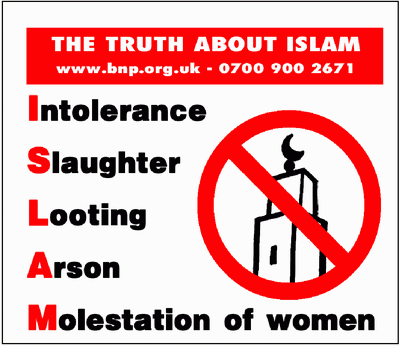
The difference between Karadžić and Wiens is simply one of degree. Unquestionably, there is a significant minority of Europeans that believes that there is no place for Muslims in Europe. While most such right-wing extremists spread their views non-violently (see picture), there are those, like Karadžić and Wiens, who evidently believe that European Muslims should be physically exterminated. It is thus reassuring that Wiens received his life sentence, and also reassuring that Karadžić is behind bars, despite the lack of progress in his trial.

The European and international justice system have so far been able to demonstrate that the brazen murder of innocents in Europe will not be tolerated. Thank God for that. However, an almost equally serious problem, in my view, is the seemingly growing political clout of openly Islamophobic movements that, while stopping short of calling for violence against Muslims, do their best to depict European Muslims as enemy aliens.

Among such groups I would count the British National Party (BNP). Last May, on a visit to England, I saw a BNP flyer which said, which no apparent shame, that Turkey should be prevented from entering the EU so that "70 million Muslim Turks" would not be able to flock to British shores. I would have thought that such open attacks on a particular group based solely on their religion would be illegal. But apparently not. Take a look at this poster, which makes it clear that opposition to Muslims (not Muslim extremists or whatever, mind, but all Muslims) is a central plank of the BNP's platform. Or look at this poster. Or this one.

Then, of course, there's the Swiss People's Party and its anti-minaret referendum, or Geert Wilders and his call for the Qur'an to be banned in the Netherlands, and for new Muslim immigrants to be kept out of the country. Lighter shades of Islamophobia are evident in Nicolas Sarkozy's campaign to legislate the clothing of Muslim women in France.

While anti-Semitism is, thankfully, on the decline in Europe, it seems that Islamophobia has very quickly taken its place. As Nick Griffin has admitted, this replacement of anti-Semitism with Islamophobia is, often, intentional. It's simply what sells these days.

-----

23 November 2007

US political scientists deny anti-Semitism accusation

John Mearsheimer, of the University of Chicago, and Stephen Walt, of Harvard University, who recently co-wrote a book entitled The Israel Lobby and U.S. Foreign Policy, have become the object of a storm of criticism. Their book alleges that US policy on the Middle East is, in many ways, shaped by a lobby that represents right-wing Israeli interests. They are careful not to equate this lobby with American Jews in general.

Nevertheless, Abraham Foxman, the director of the Anti-Defamation League, has accused Mearsheimer and Walt of spreading "classic anti-Semitic canards". Indeed, so incensed is Foxman by the arguments presented in The Israeli Lobby, that he has written his own book, The Deadliest Lies: The Israel Lobby and the Myth of Jewish Control, as a rebuttal.

According to Walt, "Reasonable people can disagree and one of the reasons we want to have a discussion is to get issues out in the open so people can talk about them." The historian Tony Judt, while disagreeing with some aspects of the book, has praised the authors for what he called their "enormous act of intellectual courage" in furthering the debate on the role of the Israeli lobby in the US (BBC).

23 October 2007

Lukašenka in hot water over anti-Semitic comments

Belarus and Israel are in the middle of a diplomatic spat over controversial comments made recently by Belarusian President Aliaksandr Lukašenka (Lukashenka) about Belarusian and Israeli Jews.

Speaking to Russian journalists in Minsk on 12 October, Lukašenka declared,

If you have been to Babrujsk [Babruysk], did you see what state the city is in? It was scary to walk into it, it was a pigsty. It was largely a Jewish city; you know how Jews act towards the place they live in. Take a look at Israel; I have been there, for one.... Under no circumstances do I want to hurt them, but they do not really make sure that the grass is mowed like in Moscow, among the Russians, or Belarusians. What a city it was.... We fixed it up, and we say to Israeli Jews: Come back, guys. I told them: Come back with money.

Five days later, the Israeli ambassador to Belarus, Zeev Ben-Arie, protested in no uncertain terms, saying that "in these comments, one can hear echoes of a myth that I had hoped had long been buried by the history of enlightened mankind, about poorly dressed, dirty, foul smelling Jews, an anti-Semitic myth." Ben-Arie also said he hoped that "Belarusian cities would reach the level of Israel's municipal services and social services in general."

Israeli Foreign Minister Tzipi Livni accused Lukašenka of anti-Semitism, saying

It is the responsibility of world leaders to battle anti-Semitism, which rears its ugly head in various places around the world, not promote it. Anti-Semitism reflects first and foremost on the community in which it appears, and on its leaders.

On 18 October, the Belarusian ambassador to Israel, Ihar Lia
ščenia (Liashchenia), issued a statement reminding Israelis that "during the last five or six centuries, Jews in our region did not feel as protected and safe anywhere as they did in the Belarusian lands.... This good attitude towards Jews, which has become traditional, persists in modern Belarus as well."

Regarding Babrujsk, Liaščenia remarked that the residents of the city,

with the help of the state, were trying to host the republic-wide harvest festival in a decent manner. The renewed, rebuilt city of Babrujsk is, among other things, a homage to many generations of members of the Jewish community whose native city this was.

"Belarus and anti-Semitism are mutually exclusive ideas," Liaščenia concluded (Белорусские новости).

One can't envy poor Liaščenia his duty of restoring calm after Lukašenka's gaffe. After all, Lukašenka managed to squeeze three typical anti-Semitic stereotypes into one statement: that Jews are allegedly dirty, that they allegedly have no attachment to the place they live in, and that they are simultaneously rich. That Liaščenia managed to turn Lukašenka's words around and portray the restoration of parts of Babrujsk as a homage to Jews is a credit to his quick thinking, or that of others in his embassy or the Belarusian foreign ministry.

Liaščenia is right on one thing. Belarus has historically been a highly tolerant place towards minorities (for instance, there were mosques in operation in Belarus centuries ago, while even in modern-day Greece and Slovenia, the very existence of mosques is a controversial issue). It remains tolerant to this day. However, as Lukašenka's words show, we Belarusians (yes, I am one) have some way to go towards living up to the image of tolerance we always congratulate ourselves with.

26 March 2007

Jewish cowboys in Argentina

I'd heard of ethnic Welsh gauchos in Argentina, but it turns out that there are Jewish ones as well. They came to Argentina from Eastern Europe in two waves: one after anti-Semitic riots (pogroms) in the 19th century, and the second after the Holocaust.

This photo series gives us a look at the life of one of them, Arminio Seiferheld, who herds livestock by day and works at a synagogue in the evening. His is, unfortunately, a vanishing way of life, however: many young members of Jewish gaucho families are moving to Argentinian cities, or to Israel (BBC).

Something Even More Magical

In other news...