Showing posts with label Guardian. Show all posts

14 November 2009

Two trials, same disease

So it turns out that Alexander Wiens, the Islamophobe who has recently been found guilty of the murder of Marwa al-Sherbini, is appealing his life sentence at the Federal Court of Justice. Let's hope this court has enough strength of character to reaffirm the sentence.

Meanwhile, the trial of Radovan Karadžić has been postponed until 1 March. Karadžić, of course, has been charged with the murder of 7,000 Muslims in Srebrenica and 10,000 people, most of them Muslims, in Sarajevo, among other crimes. So far, he has been able to obstruct his trial by boycotting it and continually asking for more time to study the charges against him. It seems, though, that, once the trial is well and truly under way, Karadžić should receive a life sentence if even one of the more serious charges against him is proven. Anything less would be a travesty of justice.

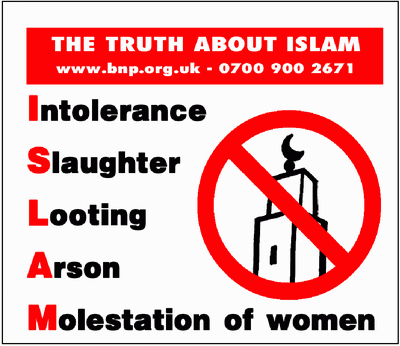
The difference between Karadžić and Wiens is simply one of degree. Unquestionably, there is a significant minority of Europeans that believes that there is no place for Muslims in Europe. While most such right-wing extremists spread their views non-violently (see picture), there are those, like Karadžić and Wiens, who evidently believe that European Muslims should be physically exterminated. It is thus reassuring that Wiens received his life sentence, and also reassuring that Karadžić is behind bars, despite the lack of progress in his trial.

The European and international justice system have so far been able to demonstrate that the brazen murder of innocents in Europe will not be tolerated. Thank God for that. However, an almost equally serious problem, in my view, is the seemingly growing political clout of openly Islamophobic movements that, while stopping short of calling for violence against Muslims, do their best to depict European Muslims as enemy aliens.

Among such groups I would count the British National Party (BNP). Last May, on a visit to England, I saw a BNP flyer which said, which no apparent shame, that Turkey should be prevented from entering the EU so that "70 million Muslim Turks" would not be able to flock to British shores. I would have thought that such open attacks on a particular group based solely on their religion would be illegal. But apparently not. Take a look at this poster, which makes it clear that opposition to Muslims (not Muslim extremists or whatever, mind, but all Muslims) is a central plank of the BNP's platform. Or look at this poster. Or this one.

Then, of course, there's the Swiss People's Party and its anti-minaret referendum, or Geert Wilders and his call for the Qur'an to be banned in the Netherlands, and for new Muslim immigrants to be kept out of the country. Lighter shades of Islamophobia are evident in Nicolas Sarkozy's campaign to legislate the clothing of Muslim women in France.

While anti-Semitism is, thankfully, on the decline in Europe, it seems that Islamophobia has very quickly taken its place. As Nick Griffin has admitted, this replacement of anti-Semitism with Islamophobia is, often, intentional. It's simply what sells these days.

-----

10 August 2009

On equality in the mosque

As some of you know, Katie and I have recently returned from a two-month trip to Europe. One thing that I love to do while travelling is to discover mosques where I can perform the Friday prayer. In Muslim countries, there are always well established mosques on hand. In non-Muslim ones, depending on how long a Muslim minority has been established there, there are either mosques that look like mosques, or there are buildings converted into mosques from other uses (such as a former cinema I found in Philadelphia), or temporary prayer facilities at university campuses. What's common between all of these places of worship is the welcome they extend to the Muslim worshipper and the sense of brotherhood that almost always emanates from them.

So imagine my surprise when, in Luton, England, I was told that, to the best of my interlocutor's knowledge, mosques there have no "arrangements" for women worshippers. He said there might be something at the university, but, at that stage, it was too late to check. It's always something of a shock to the system to find yourself amid the ultra-conservative Muslims of Luton. Never did I think, though, that the community, which has been in Britain for two or three generations, would continue the common South-Asian practice of excluding women from the mosque. Especially since Luton itself features Islamic schools with female students and women teachers.

My mosque in Dhaka has a women's section, albeit, from what I hear, a small, crowded one, with no view of the men's prayer halls. So Katie was able to attend the mosque in Bangladesh in 2006, but not in Britain in 2009.

After Britain came Belarus. Minsk, my native city, is home to a long-standing Tatar community, present there for over 500 years. There was a mosque in Minsk for most of this time but, tragically, it was first expropriated and then blown up by the city authorities under Communist rule. Since 1997, however, a new mosque has been under construction (very much a stop-go process; the small Belarusian Muslim community is short on funds). The building site features a make-shift structure that serves as a temporary mosque while construction continues. It's actually quite beautiful inside, and includes a women's section, although, again, a small one. Katie and I prayed at this mosque when we were in Minsk; the other places we went to in Belarus didn't have mosques, as far as we knew.

The big shock came in Turkey. Ostensibly, Turkish Islam is all smiles and all kindness. The Turkish Muslims we know are genuinely warm and kind-hearted people, ma sha' Allah. However, something about the way Islamic institutions are managed in Turkey is badly broken. In Istanbul, the mosque where I went for Friday prayer most weeks (because it was located close to the apartment we were staying in) had no women's section.

So one day, Katie and I went off in search of a place where the two of us could perform Friday prayer together. We went to two different mosques in another neighbourhood, and the results were even more surprising. It turned out that both those mosques did have women's sections, BUT those sections were taken over by men during Friday prayers. Thus, of the 35 congregational prayers a week, women could pray at the mosque 34 times. However, they were obliged to stay away for just one prayer, which just happened to be the most important one of the week. Compounding the double standards (if not outright hypocrisy) is the fact that, in one of those mosques, the Friday sermon was about the importance of family, while the prayer featured verses from the Qur'an about the importance of Friday prayer. Hello?

So it was quite comical (sadly so) to see an official from Diyanet, the Turkish governmental agency in charge of Islamic institutions, saying, after a mosque designed by a female architect opened, that Turkey should build more such mosques. That mosque is the first in Turkey designed by a woman, and the first to feature a women's prayer hall equal in size to the men's one. The joke lies in the fact that there is no move underway by Diyanet to admit women into the mosques which currently bar them from taking part in Friday prayer, even though they already have women's sections.

On our way home to Montreal, Katie and I stopped by the Muslim prayer rooms at Atatürk International Airport in Istanbul to perform the fajr prayer. The women's prayer room was spacious and well equipped, but infested with cockroaches. Not surprisingly, I didn't see any cockroaches in the men's one. Katie was glad to leave Turkey, and I don't blame her.

So now we're in Perrysburg, Ohio, visiting my in-laws. Katie and I got married at the mosque here, the Islamic Center of Greater Toledo (see picture), in 2005. This is probably the most equitable of all purpose-built mosques I've seen anywhere in the world when it comes to ensuring women's access to prayer facilities. The prayer hall is simply divided down the middle with a low barrier; men have half the space, while women have the other. The barrier is high enough to ensure modesty, yet not high enough to create a sense of segregation. Men and women have equal access not just to the prayer space, but to the other elements of the mosque, such as the high dome and the stained-glass windows, that give it beauty and help in the contemplation of the Divine.

As Jimmy Carter reminded us last month, "it is simply self-defeating for any community to discriminate against half its population." It is high time for us Muslims around the world to start paying much more attention to the Prophet's (peace be upon him) injunction: "Do not prevent the maid-servant of God from going to the mosque" (Bukhari).

[This post was written in Perrysburg.]

Something Even More Magical

In other news...